
Make your albums last longer and sound better with these easy solutions
In the last article, I talked about cleaning and the importance of cleaning your albums. In this article I want to talk about how I take care of my albums and offer some recommendations so that your records and sleeves stay in the best condition possible over time. Taking good care of your records is crucial in keeping them safe and sounding as good as possible over the long haul.
The first step in any process is to clean the albums, but once they are cleaned and dried there are a few things that you should consider doing before putting them away. Number one is toss out those awful paper inner sleeves and replace them with nice rice paper, or even better archival inner sleeves. I personally prefer the archival inner sleeves and even replace rice paper sleeves with them. I like the look and feel they offer, and I believe they offer much better protection for the albums themselves. Many new albums come in nice printed or custom inner sleeves. They look awesome, but the biggest problem is that they add a ton of static to your albums, and they are paper and can scuff or scratch your record. Don’t throw them away but put the records in a better sleeve so they stay shiny, scuff free, and beautiful. Here are some recommendations for sleeves that will keep your albums static free and sounding great.
Best Bang for the Buck – Hudson HiFi – 500 Anti-Static Archival Inner Sleeves
Hudson HiFi – 100 Anti-Static Archival Inner Sleeves
MOFI Original Master Sleeves – The standard in archival inner sleeves
Number two is to put your album in an outer sleeve. What this does is protect the jacket from wear and tear, and it keeps dust particles away from your albums. Dust is a major cause of surface noise on records. By adding the extra protection of an outer sleeve, there are less places dust can creep in and get on the record surface. There are many kinds of outer sleeves available at all sorts of price points. You can get outer sleeves that reseal as even more protection against dust and debris. They tend to cost a little more per sleeve, but if you have a dusty home, or pets that shed all over, it may be worth the investment. Also consider the thickness of the sleeve when buying. It may not seem like much, but a three mil outer sleeve gives much more stability and sturdiness than a two mil outer sleeve. You really can and will notice the difference just by holding them in your hands. I personally prefer a three or four mil sleeve for my albums. Another thing to look at is the clarity of the sleeve. Many will advertise a clear outer sleeve, but when you get them, they are cloudy. The album jacket might look fine when placed in the sleeve, but I prefer to buy sleeves that advertise ultra clear on the package so that my covers pop better (it’s just a personal preference though).
Over the years, I have tried numerous different brands of outer sleeves with many different results. I found some tend to tear more than others and have even found some where every package would have at least one sleeve that was too small to fit a standard album jacket in it, and after buying that brand three different times I gave up on them for good. Here are some outer sleeves that I have found to be top notch with minimal issues.
MOFI Ultraclear Record Outer Sleeves – My favorite non-gatefold outer sleeve
Invest In Vinyl Outer Sleeves – Not ultra clear, but very good sleeves
So, you might be wondering about gatefold jackets, and for the longest time I was not happy with the options out there. The goal for me of sleeving your albums is to protect the jackets and keep them safe. With many of the gatefold sleeves out there the albums just slide into a dual open-ended sleeve. Not only can the jacket itself just slide out, but the albums also aren’t very safe in them either. I have given up trying to find a good gatefold sleeve, but I did find an answer to my problem thanks to Vinyl Storage Solutions (VSS). VSS offers a patented sleeve they call the dual pocket outer sleeve. This sleeve allows you to seal your album jacket in one sleeve and gives you a pocket to put your records in for easy access. This is an awesome sleeve for protecting your jackets, but what I use it for is making a custom gatefold sleeve. Since the jacket uses tape (there is a tapeless option, but it won’t work for gatefolds), You are able to slide one side of your gatefold in one, and the other side of your gatefold into another then use the tape to seal your gatefold jacket inside. As I mentioned, these sleeves are dual pockets, so that means it offers you two pockets (one inside the gatefold, and one on the rear of the gatefold) to house your records. Now you are a nice and convenient way to access your records while keeping your gatefold jacket sealed and safe. Here is a video showing how I created this gatefold sleeve.
VSS has numerous sales throughout the year, so I do recommend buying in bulk as you do need two sleeves per gatefold and they come in packages of 25 sleeves. I typically will be two packages at a time which can make 25 gatefold sleeves. I am a huge fan of VSS and use them also for my compact disc collection as well. I like to sleeve my digi packs to keep that artwork as clean as I can.
Number three is how you store your albums. Now that we have a collection going, what is the best way to store them? People have used crates, bins, shelves and any number of storage solutions, but the number one rule of vinyl records is NEVER stack your albums. Stacking your albums one on top of another adds weight and over time that can cause damage to the records and the jackets. Always find a solution that allows your albums to stand in an upright position. NEVER overfill a storage space. That means do not pack them in as tight as you can. Give your albums a little wiggle room to breathe and it will save your jackets from getting crushed. Albums are not books; they will smush under heavy pressure.
Most record collectors like to buy cubical shelving units to store records. I started with cubical shelves for my collection, and they work fantastically. Your albums will sit upright, you will be able to (in most cases) read the spine of the jacket to find the album you want, and it looks pretty darn cool as well. The cubical shelving also gives more sturdiness to the unit. Records get heavy when you have a lot, so your solution needs to be able to handle a good amount of weight. Because of this, not just any cubical shelve will do. Some are out there that have thin separators between the cubes. I found that too many albums on one shelf caused the thin particle wood to break through the brace that holds it up. A good idea is to reinforce those thin shelves whenever possible. I recommend finding a sturdy shelf unit with thicker dividers. One that is loved by collectors everywhere is the IKEA KALLAX shelves (which are still sold today). You can stack them on top of each other safely (be sure to reinforce them either to a stud in your wall or two each other though), and they look nice. KALLAX Shelf unit, black-brown, 30 3/8×57 7/8” – IKEA
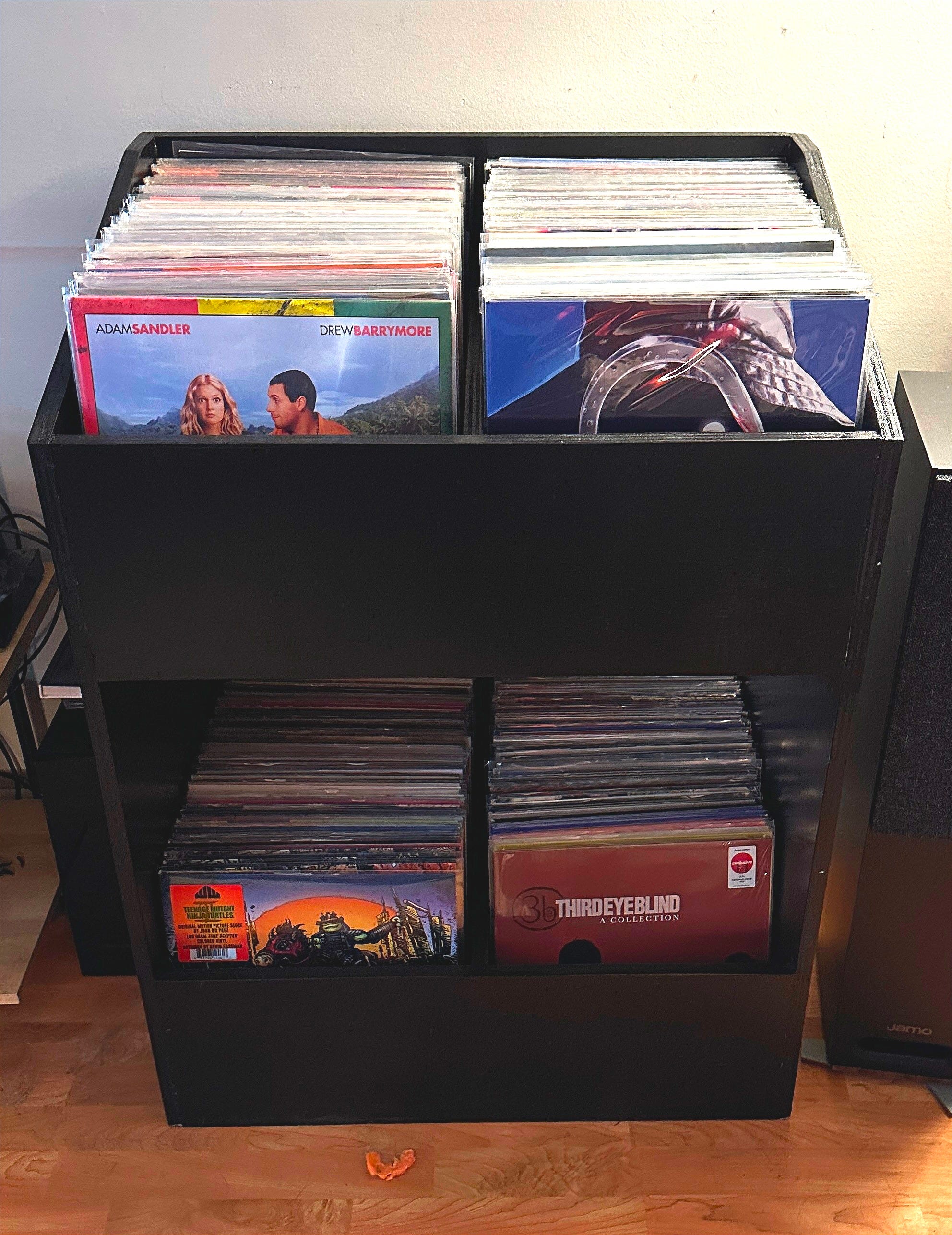
Another nice option is to use flip bins. These are bins just like you find in record stores and allow you to flip through the albums and see the album cover when flipping. Flip bins do take up more space than their cubical counterparts, but this option is all about the feeling you get when flipping through and looking for what to spin next. I personally had custom bins made for me that I painted and fit into my rooms, and I love them. Each bin can hold up to 400 albums each give or take 10-20 albums depending on gatefold sleeves, outer sleeves, and album thickness. The key to flip bins is to leave enough room to give yourself a nice flip through experience without straining to see the next album. Here is a link to the build instructions I used to have these flip bins made if you are interested in doing the same. https://johnvantine.com/i-built-a-vinyl-record-shelf/
That is going to do it for this article, and I hope you enjoyed reading it. Let me know how you take care of your albums. Everybody does it differently, so please share your tips and techniques. I am always looking for peoples tried and true methods, tips and expertise. Until next time, keep calm and spin vinyl.